


A straightforward guide to corrugated packaging — the layers, the language, and what "sustainable" actually means when it's printed on a box.
Most people don't think about the box until the box fails. A corner crumbles in transit. A product arrives damp. A stack collapses in a warehouse at 2 AM. That's when the conversation about packaging really begins — and by then, it's too late.
At BoxCraft, we think it's far better to have that conversation before the shipment leaves the floor. So here it is: everything you genuinely need to understand about corrugated packaging, written plainly, without the jargon, and without the sales pitch dressed up as education.
Corrugation 101 — What's Actually Inside Your Box
A corrugated box is not simply a thicker cardboard. It's an engineered structure — and understanding that structure changes how you think about every packaging decision you make.
At its core, corrugated board consists of two elements: the liner (the flat outer sheets you can touch) and the fluting (the wavy, arched medium sandwiched between them). That wave isn't decorative. It's structural. The arches distribute pressure across the board, which is the same principle that makes a Roman arch hold up a stone bridge. Pound for pound, corrugated board is extraordinarily strong.
The Flute Family
The fluting itself comes in different profiles, named alphabetically — A, B, C, E, F — each with a different wave height and density. A-flute is tall and gives excellent cushioning, making it ideal for fragile goods. B-flute is shorter and denser, which suits canned goods and display boxes because it's more puncture-resistant and prints more crisply. C-flute is the workhorse — it sits between A and B and covers the broadest range of general shipping needs. Then there are the microflutes — E and F — which are almost paper-thin, used for retail packaging where finesse matters more than load-bearing.
Why does this matter? Because when someone sells you a "corrugated box," they haven't told you nearly enough. The flute profile, the liner grade, and the number of layers — these are the variables that actually determine whether your packaging performs.
3-Ply vs 5-Ply vs 7-Ply — How the Decision Is Actually Made
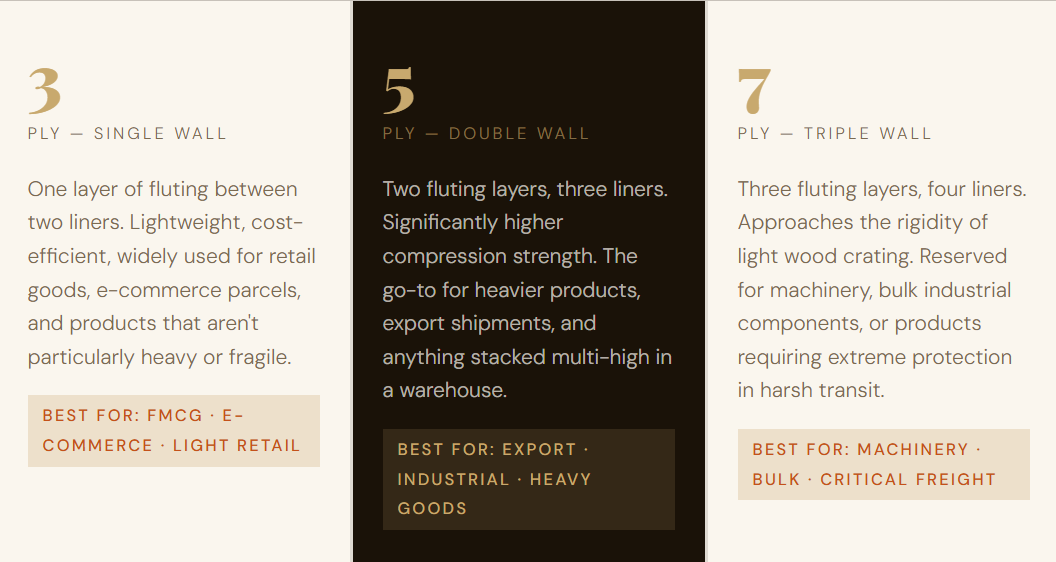
"Ply" refers to the number of layers in the board construction. More plies means more fluting layers, more liners, and — generally — more strength and rigidity. But the decision isn't simply more is better. It's about matching the board to the job.
Here's how to think through it honestly:
The Real Variables in the Decision
Product weight and fragility are the starting point. A 2 kg ceramic lamp and a 2 kg bag of rice have entirely different packaging requirements, despite weighing the same.
Transit conditions matter enormously. A box travelling a single leg by road to a nearby city faces a very different journey from one loaded onto a container ship bound for Europe, then transferred to rail, then a lorry. Each additional handling point adds risk — and your ply specification should reflect that.
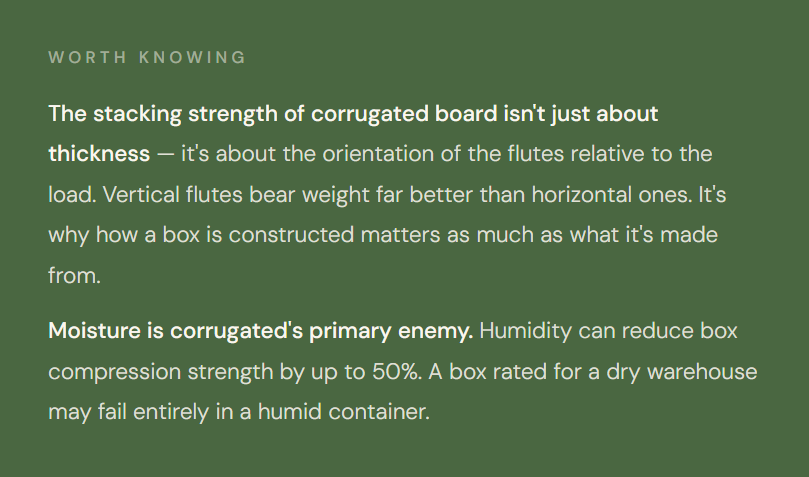
Stacking requirements — both in transit and in storage — determine compression load. A box sitting alone on a shelf needs far less compressive strength than one at the bottom of a pallet of six identical boxes.
Print ambitions are often overlooked. Finer graphic work — particularly the kind of detail possible with offset printing — performs best on smoother, higher-grade liners, often in 3-ply constructions. If brand presentation matters (and it increasingly does), the board specification feeds directly into print quality.

At BoxCraft, offset printing is part of how we approach the surface of the box as a brand canvas, not just a container. Offset delivers richer colour, sharper detail, and a consistency that digital printing on corrugated simply cannot match at scale. But unlocking that quality requires the right liner specification — which is why the structural and the visual decisions need to be made together, not separately.
